
Understanding the Structure of GST in India
Imagine India as a huge pizza. Every state is like a slice, and the central government is the one who baked the pizza. Now, when someone eats (consumes goods/services), both the central government and the state want their fair share of revenue.
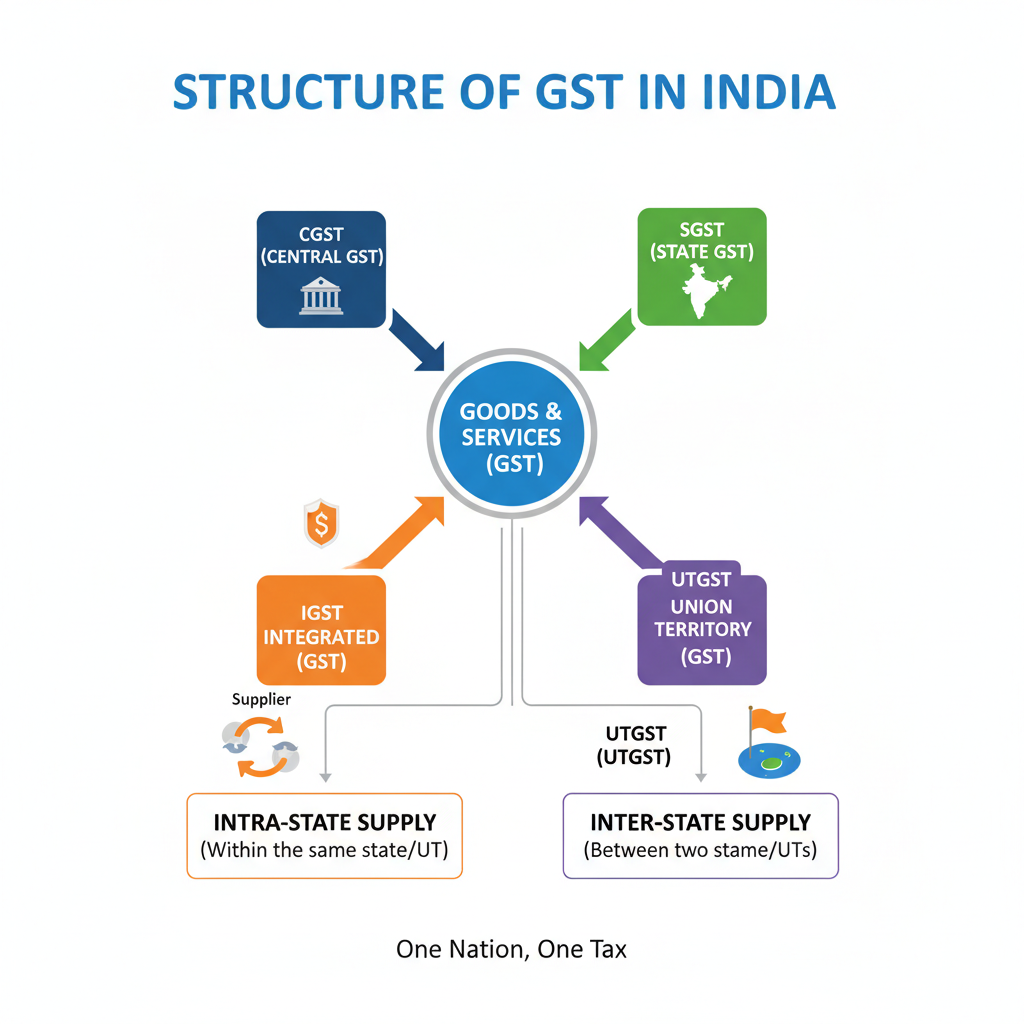
That’s exactly why GST in India follows a dual structure—the center collects its part (CGST), and the state collects its part (SGST). For goods/services crossing state borders, a special tax (IGST) kicks in.
The Dual GST Model in India
India chose a dual GST model because of its federal system. Unlike some countries (like Singapore) that have a single national GST, India wanted both the center and the states to retain taxing power.
“In simple terms, whenever GST is applied to a product or service, here’s how it gets divided:”
- The center takes its part → Central GST (CGST)
- The state/UT takes its part → State GST (SGST) or Union Territory GST (UTGST)
“This way, both the Centre and the States get their fair share of tax revenue, while people and businesses enjoy a single, uniform system across India.”
-
Components of GST
- CGST (Central Goods and Services Tax)
Collected by the Central Government. Applicable on intrastate transactions (sale within the same state).
Example: A bakery in Delhi sells a cake to a customer in Delhi. Both CGST and SGST apply. - SGST (State Goods and Services Tax)
Collected by the State Government. Also applicable on interstate transactions.
Example: For the Delhi bakery, CGST goes to the Center, and SGST goes to the Delhi Government. - IGST (Integrated Goods and Services Tax)
Collected by the Central Government. Applicable on interstate transactions (sales across state borders).
Example: The Delhi bakery sells a cake to a customer in Mumbai → IGST is charged, and later the center shares revenue with Maharashtra. - UTGST (Union Territory Goods and Services Tax)
Similar to SGST but applies in Union Territories without legislatures (like Chandigarh, Lakshadweep, and Andaman & Nicobar).
Example: A restaurant in Port Blair (Andaman) charges CGST + UTGST.
I will simply show it in a table for easy understanding:
| Type of GST | Collected By | Applicable On | Example |
| CGST (Central Goods and Services Tax) | Central Government | Intra-state transactions (within the same state) | A bakery in Delhi sells a cake to a customer in Delhi → CGST + SGST apply |
| SGST (State Goods and Services Tax) | State Government | Intra-state transactions (within the same state) | From the same Delhi bakery sale, SGST goes to the Delhi Govt, and CGST goes to the Centre. |
| IGST (Integrated Goods and Services Tax) | Central Government | Inter-state transactions (between different states) | Delhi bakery sells a cake to a customer in Mumbai → IGST charged, the center later shares with Maharashtra |
| UTGST (Union Territory Goods and Services Tax) | Union Territory Government (without legislature) | Supplies within Union Territories | A restaurant in Port Blair (Andaman) charges CGST + UTGST |
How GST Works in Real Life
Suppose we take an example:
- A manufacturer in Maharashtra makes mobile phones.
Simple memory trick: CGST + SGST = Same state IGST = Different states (or import/export) - He sells them to a distributor in Gujarat. → IGST
- The distributor sells them to a retailer in Gujarat. → CGST + SGST
- The retailer sells them to a customer in Gujarat. → CGST + SGST
This way, tax flows smoothly without double taxation.
Old vs. New Tax System
Old System (Before GST):
- Excise duty on production
- CST (Central Sales Tax) on inter-state sale
- VAT on intra-state sale
- Entry tax at state borders
New System (After GST):
- Only IGST for inter-state trade
- CGST + SGST for intra-state trade
- No entry tax or CST hassles
GST Rate Slabs—A Deeper Dive
GST is levied in slabs: 0%, 5%, 12%, 18%, and 28%. See with examples:
- 0% (Essentials) → fresh milk, rice, wheat, vegetables.
- 5% (daily use) → tea, coffee, sugar, and footwear below ₹1,000.
- 12% (standard needs) → processed food, smartphones, and packed juices.
- 18% (Common goods & services) → laptops, restaurants, movie tickets, OTT streaming.
- 28% (luxury & sin goods) → big cars, tobacco, and high-end cosmetics.
- Special rates → Gold (3%) and precious stones (0.25%).
Case Study: A Textile Shop Owner
Meet Ramesh, who owns a textile shop in Tamil Nadu.
- Sells sarees to local customers → CGST + SGST.
- Sells sarees online to Karnataka → IGST.
- Exports sarees to the USA → Zero-rated under GST.
Benefits to Ramesh:
- No cascading taxes
- Can claim Input Tax Credit (ITC)
- Easier digital filing
Destination-Based Tax
One of the biggest changes under GST is that it’s destination-based, not origin-based.
Example: A company in Punjab makes biscuits and sells them to a retailer in Delhi. Under GST, Delhi collects the tax (where consumed).
Revenue Sharing
When GST is collected:
- Intra-state supply → CGST goes to the center, SGST to the state.
- Inter-state supply (IGST) → Collected by the center, later distributed to the destination state.
Numerical Example
Suppose you buy furniture worth ₹10,000 in Karnataka. GST rate = 18% (9% CGST + 9% SGST).
- Price = ₹10,000
- CGST = ₹900 (goes to the center)
- SGST = ₹900 (goes to Karnataka Govt)
- Final Price = ₹11,800
If bought from Tamil Nadu (inter-state): IGST = ₹1,800 (collected by the center and later shared with Karnataka).
GST in Union Territories
UTs like Chandigarh, Daman & Diu, Lakshadweep, and Andaman don’t have legislatures. So instead of SGST, they levy UTGST.
Example: A hotel in Chandigarh charges CGST + UTGST.
GST and the E-Way Bill
- Mandatory for goods worth more than ₹50,000 transported across states.
- Tracks goods movement digitally.
- Prevents tax evasion.
- Simplifies logistics.
Key Benefits of GST Structure
- Uniformity—the same system across India.
- Transparency—clear breakdown of CGST, SGST, and IGST.
- Revenue fairness—destination states benefit.
- Ease for business—smooth interstate trade.
- Digital compliance – e-way bills, GST portal.
FAQs on GST Structure
Q1. Why does India have both CGST and SGST?
👉 Because India follows a federal structure, and both the center & the states need revenue.
Q2. Who gets IGST revenue?
👉 The Central Government collects IGST, then transfers a share to the destination state.
Q3. Is GST the same in all states?
👉 Yes, GST rates and laws are uniform across India, though minor exemptions exist.
Conclusion: The Backbone of GST
The structure of GST may seem complicated at first, but it’s actually logical and fair. By balancing power between the center and states, ensuring destination-based taxation, and simplifying trade across borders, GST has created a more unified Indian market.
➡️ In Part 3, we’ll cover GST Registration & Compliance—who needs to register, how to file returns, penalties, and benefits for small businesses.
Part 1 link: click here
SSC Official website: Click Here