
Stay Updated with Daily Current Affairs—June 10 & 11, 2025
Welcome to your trusted source for daily important current affairs, specially curated for competitive exam aspirants, students, and knowledge seekers. The updates for June 10th & 11th, 2025, have been carefully compiled from reliable sources to help you stay informed and exam-ready. Whether you’re preparing for SSC, RRB, UPSC, banking, or simply love staying updated—these crisp and relevant notes are your go-to reference for effective learning.
National Affairs
Appointments & governance
In a major governance reshuffle aimed at bolstering administrative efficiency and sectoral performance, the Indian government appointed Vivek Kumar as the new chairman of the Finance Commission, effective June 10, 2025.
- What: Appointment of Vivek Kumar as Chairman of the 16th Finance Commission.

- Why: To ensure fair and effective revenue distribution & fiscal stability across states.
-
When: Official appointment made on June 10, 2025.
- Where: Appointment announced in New Delhi by the Ministry of Finance.
-
Whom: Vivek Kumar, seasoned policy expert & former economic advisor.
- Purpose: Recommend tax devolution formula for 2026–31 period; reduce regional imbalances.
Infrastructure & urban sustainability
As India steps into a new demographic era, having officially become the world’s most populous country in 2025, the government has launched a bold, future-ready initiative to transform urban living. With a massive $205 billion investment, announced in June 2025, India aims to build smarter, greener, and more sustainable cities under a renewed infrastructure and urban sustainability mission.
- What: $205 billion infrastructure & sustainability plan for urban transformation across India.

- Why: To meet the urgent needs of a growing urban population, address climate change, and improve livability in cities and small towns.
- When: Announced and launched in early June 2025; rollout begins in phases from Q3 2025.
- Where: Pan-India with special focus on Tier-2 & Tier-3 cities, including hubs like Bhopal, Surat, Ranchi, and Vishakhapatnam.
- Whom: Led by the Ministry of Housing & Urban Affairs with support from state governments, the private sector, and global agencies like the World Bank and AIIB.
- Aim: To create sustainable, climate-resilient, inclusive urban infrastructure that supports India’s economic and environmental goals.
- Purpose: Drive long-term development through green energy, smart mobility, clean water access, digital connectivity, and better living standards.
International Affairs
Austria school shooting
On June 10, 2025, just before 10 a.m., Artur A., a 21-year-old former student, entered his old high school, BORG Dreierschützengasse in Graz, Austria, armed with a legally obtained Glock 19 handgun and a shotgun.
- What: A mass shooting at a secondary school, resulting in 10 deaths (nine students (aged 14–17) and one teacher) and 11
 wounded; the perpetrator also died.
 - When: Occurred on June 10, 2025, from ~09:55 to 10:07 CEST.
- Where: Took place at BORG Dreierschützengasse, Lend district, Graz, Styria, Austria.
- Who: Artur A., 21, a former student with no criminal record; legally owned a handgun and shotgun.
- Aim/Purpose: He planned the massacre, leaving behind a bomb, attack plan, and farewell messages—not to claim ideology but possibly revenge or to protest bullying; motive remains unclear.
- Why: Investigators noted deep isolation, immersion in violent gaming, a history of bullying, dropout status, and mental health concerns—but no definitive motive was confirmed.
- Attack timeline: Police responded within minutes; the shooter died by suicide in the bathroom after ~40 rounds were fired.
Israel–Yemen cross-border tensions
In a dramatic and unprecedented escalation on June 10–11, 2025, Israel for the first time carried out a naval missile strike on Hodeida’s Houthi-controlled port in Yemen, citing intelligence that docks were being used to smuggle Iranian-supplied weapons and launch drones and missiles at Israeli targets.
- Who: Israeli Defense Forces (IDF) vs Houthi rebels controlling Hodeida, backed by Iran.
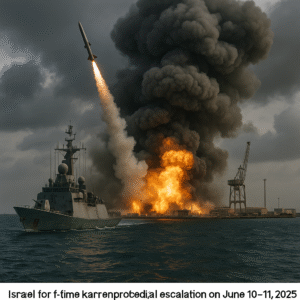
- What: Navy-launched missile strikes on Hodeida port, the first such maritime strike by Israel, following earlier IDF air raids on Sanaa airport and ports.
- When: June 10–11, 2025, with prior escalation from May airstrikes targeting Hodeida, Salif ports, and Sanaa airport after Houthi missile launches in early May.
- Where: Red Sea coast—chiefly the docks of Hodeida port, a Houthi stronghold in Yemen.
- Why: Israel claims the port was being used to funnel weapons and launch unmanned drones/missiles at its territory, retaliating against persistent Houthi cross-border attacks in solidarity with Gaza. The Houthis have launched over 100 missiles/drones since late 2023, including hypersonic missiles aimed near Ben Gurion Airport.
- Aim/Purpose: To degrade Houthi military capacity, raise the cost of hostile actions, deter future strikes, and disrupt arms smuggling lines. It also signals Israel’s readiness to extend deterrence beyond airspace into maritime zones.
- Impact: Heightened risks to humanitarian aid flows via Hodeida, potential global shipping disruptions through the Bab el‑Mandeb, and the deepening of a regional proxy confrontation—possibly pulling in U.S., Saudi, and Iranian interests
South Korea’s diplomatic steps
In recent days, South Korea has taken bold diplomatic strides under President Lee Jae-myung’s administration, signaling a shift toward engagement and regional stability. On June 10–11, Seoul halted its loudspeaker propaganda broadcasts along the DMZ—a reciprocal gesture following Pyongyang’s pause—to build mutual trust at the border.
- What: Ceasing DMZ loudspeaker broadcasts; phone calls with China, Japan, and the U.S.; new embassies with Syria and Cuba.

- Why: Reduce border tensions, encourage denuclearization, deepen economic/security cooperation, and complete diplomatic outreach.
- When: Loudspeakers halted June 11, calls on June 10, Syria ties formalized April 10, Cuba embassy inaugurated June 10.
- Where: DMZ border; phone diplomacy; diplomatic relations in Seoul and Damascus.
- Who: President Lee Jae-myung (ROK), Xi Jinping (China), Shigeru Ishiba (Japan), Donald Trump (U.S.), and Cho Tae-yul (Foreign Minister).
- Aim: Promise broader engagement: restore inter-Korea trust, diversify alliances, and strengthen international position.
New US-China trade dynamics
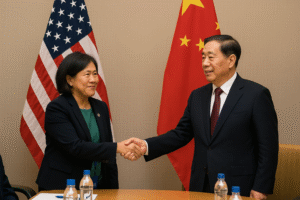
In June 2025, the global economic spotlight returned to the complex trade relationship between the United States and China, as both nations entered a new phase of negotiations aimed at restructuring tariffs and boosting digital and green technology cooperation
| Category | Details |
|---|---|
| What | New trade framework and negotiations between US and China |
| Why | To reduce tensions, address tech restrictions, and rebuild economic ties |
| When | Talks resumed on June 10, 2025, at the Bali Economic Forum |
| Where | Bali, Indonesia (official diplomatic summit) |
| Who | US Trade Rep Katherine Tai, China Vice Premier He Lifeng |
| Aim | Normalize trade, reduce tariffs, foster green tech and AI cooperation |
| Purpose | Promote mutual economic stability and avoid full economic decoupling |
| Topics Discussed | Tariff rollback, semiconductor export, AI regulation, EV supply chains |
| Outcome | Creation of a joint Economic Coordination Office, pledge to continue structured dialogue |
| Global Impact | Eases global market jitters, influences India, ASEAN, EU supply chains |
Economics & Business
World Bank downgrades global growth
In June 2025, the World Bank released its latest Global Economic Prospects report, downgrading the global growth forecast for 2025 to 2.4%, slightly lower than the earlier estimate of 2.7%.
- What: Global growth forecast for 2025 downgraded from 2.7% to 2.4%.
- Why: Due to geopolitical risks, weak demand, high interest rates, and conflicts.
- When: Announced in the June 2025 Global Economic Prospects report.
- Where: Issued from Washington, D.C., by the World Bank headquarters.
- Who: Report published by the World Bank’s Development Economics Group.
- Aim: To provide an updated global outlook and guide policymakers worldwide.
- Impact: Slower global trade, reduced investments, higher pressure on poor nations.
- Bright Spots: India, Indonesia, and the Philippines are expected to maintain resilient growth.
UK spending review
On 11 June 2025, Chancellor Rachel Reeves unveiled a landmark Spending Review designed to “renew Britain,” shifting away from years of austerity toward ambitious investment across health, defense, infrastructure, energy, and housing.
- What: A multiyear Spending Review setting budgets for 2026–29 (resource) and capital in 2029–30.

- Why: To pivot from austerity, renew national infrastructure, boost economic growth, reduce hospital waiting lists, and restore public services. Mental focus on “securonomics.”
- When: Announced on 11 June 2025, covering the next 5 years.
- Where: Presented at 11 Downing Street, published via HM Treasury and GOV.UK.
- Who: Chancellor Rachel Reeves, under PM Keir Starmer’s Labour government.
- Aim/Purpose: “Renew Britain” by investing in health (NHS), defense, housing, transport, and energy while driving departmental efficiency and maintaining fiscal credibility.
- Funding & Trade-offs• £190 billion total public service boost; £113 billion capital investment
• Efficiency savings (~£14 bn/year) & revised fiscal rules
• Potential tax adjustments in autumn budget flagged by Reeves. - Winners & LosersWinners: Health (+3%), defence (2.6% GDP), social housing (£39 bn), energy (Sizewell C £14 bn), insulation (£13.2 bn), transport upgrades.
Squeezed: Home Office, Foreign Office, environment, culture, local government see real‑terms cuts. - Risks & CriticismsSkepticism over delivery, realism of efficiency savings, looming tax rises, police funding shortfalls, delayed returns on capital investments, and underfunded departments.
Science & Technology & Environment
ESA Solar Orbiter milestone
In June 2025, the Solar Orbiter achieved a major milestone by completing its first full close solar encounter (perihelion) at just 0.28 AU (about 42 million km) from the Sun—closer than Mercury’s orbit—capturing the most detailed images of the solar poles ever taken.
- What: ESA Solar Orbiter is a solar observation spacecraft designed to study the Sun up-close, especially its poles.

- Why: To understand how the Sun generates and controls the heliosphere (the solar magnetic bubble that surrounds our solar system) and to improve space weather prediction.
- When: Launched on February 10, 2020; latest milestone achieved in June 2025 with a close flyby (perihelion) near the Sun.
- Where: Launched from Cape Canaveral, USA; orbits within 0.28 AU of the Sun (closer than Mercury).
- Who: Led by the European Space Agency (ESA) in collaboration with NASA; involves global scientists and engineers.
- Aim: To provide unprecedented views of the Sun’s polar regions and unravel the mysteries of solar magnetic activity and eruptions
Data center infrastructure boom in India
India is witnessing a massive boom in data center infrastructure driven by the explosive growth in digital adoption, AI deployment, 5G rollout, and cloud services.
- What: A large-scale expansion of data center infrastructure across India.

- Why: Driven by rising demand from AI technologies, 5G, cloud computing, digital banking, and streaming services; also fueled by data localization laws and low-latency needs.
- When: Rapid growth between 2023 and 2027, with peak investments and construction ongoing in 2025.
- Where: Major hubs include Mumbai, Chennai, Hyderabad, Noida, Bengaluru; emerging centers in Pune, Visakhapatnam, Kolkata.
- Who: Key players: AdaniConneX, NTT, Yotta, Bharti Airtel Nxtra, STT GDC, Hiranandani Group, AWS, Microsoft Azure, Google Cloud.
- Aim: To build hyperscale-ready, secure, energy-efficient data centers that serve both domestic and global digital demand.
- Government Support: Includes National Data Centre Policy, PLI schemes, and incentives for renewable energy usage, especially in green data centers.
Ocean acidification “boundary breached”
Ocean acidification has officially crossed a critical planetary boundary, according to a new 2025 report by Earth Commission scientists published in Nature
- What: Ocean acidification has exceeded its safe planetary boundary.

- Why: Due to excessive carbon dioxide emissions from human activities.
- When; Confirmed in June 2025 in a Nature journal study.
- Where: Global oceans—most affected: upper ocean layers across the Pacific, Atlantic, and Indian Oceans.
- Who: Report by the Earth Commission, involving over 50 international climate and marine scientists.
- Aim: To assess if Earth’s systems remain within “safe and just” boundaries for humans and ecosystems.
Economic Policy & Analysis
US stagflation concerns
In June 2025, renewed fears of stagflation—a rare combination of stagnant economic growth, high inflation, and rising unemployment—have gripped the United States economy, sparking widespread debate among economists, policymakers, and investors.
- What: Fears of stagflation in the U.S. economy, marked by low growth, high inflation, and rising unemployment.

- Why: Inflation remains above 4%, GDP growth is stalling (~1.1% in Q1 2025), and job growth is slowing, all despite tight monetary policy.
- When: Concerns peaked in early June 2025, after release of weak labor market and GDP data.
- Where: United States, with ripple effects expected globally, especially in financial markets and trade-dependent nations.
- Who: U.S. Federal Reserve, Department of Labor, financial institutions, and global investors are closely involved.
- Purpose: Ensure price stability, support job creation, and protect long-term economic confidence.
- Impacts: Could influence Fed interest rate decisions, affect global stock markets, pressure corporate earnings, and reshape consumer confidence.
- Solutions Being Discussed: Balanced fiscal policies, avoiding overdependence on rate hikes, boosting productivity, and increasing domestic supply chain resilience.
Offical link SSC: Click Here